
Is our future now upon us?
Has the Urantia movement attained critical mass, or do we need substantive reform?

I’ve been off the grid, so to speak, dealing with pressing personal matters. But now I am back in one piece—even if I did have a major operation among other challenges. Meanwhile, the beat goes on with the inquiry we started back in February: What is the future of our beloved and precious U-movement?
Or, we could pose it another way: perhaps our movement’s future is already here. This very moment—right now—this is our real future, manifesting itself.
After all, it was the 1960s media theorist Marshall McLuhan who once quipped “the future of the future is the present.” Think on that one. You can construe this witty line either way, positive or negative.
And, consider the possibility that McLuhan was also right that the “medium is the message.” Remember that old slogan that made him famous?
In our case, the medium would refer to a 2,000+ page book published in 1955, and its message is based in the liberal, optimistic, mainline Protestantism of the early twentieth century—this being the scholarly group out of which the revelators chose many crucial human sources. The “future” of this message culminated in the few decades after 1955.
Please talk to me about this one in the chat, okay? (and also hit that ‘like’ or ‘subscribe” button, some of you).
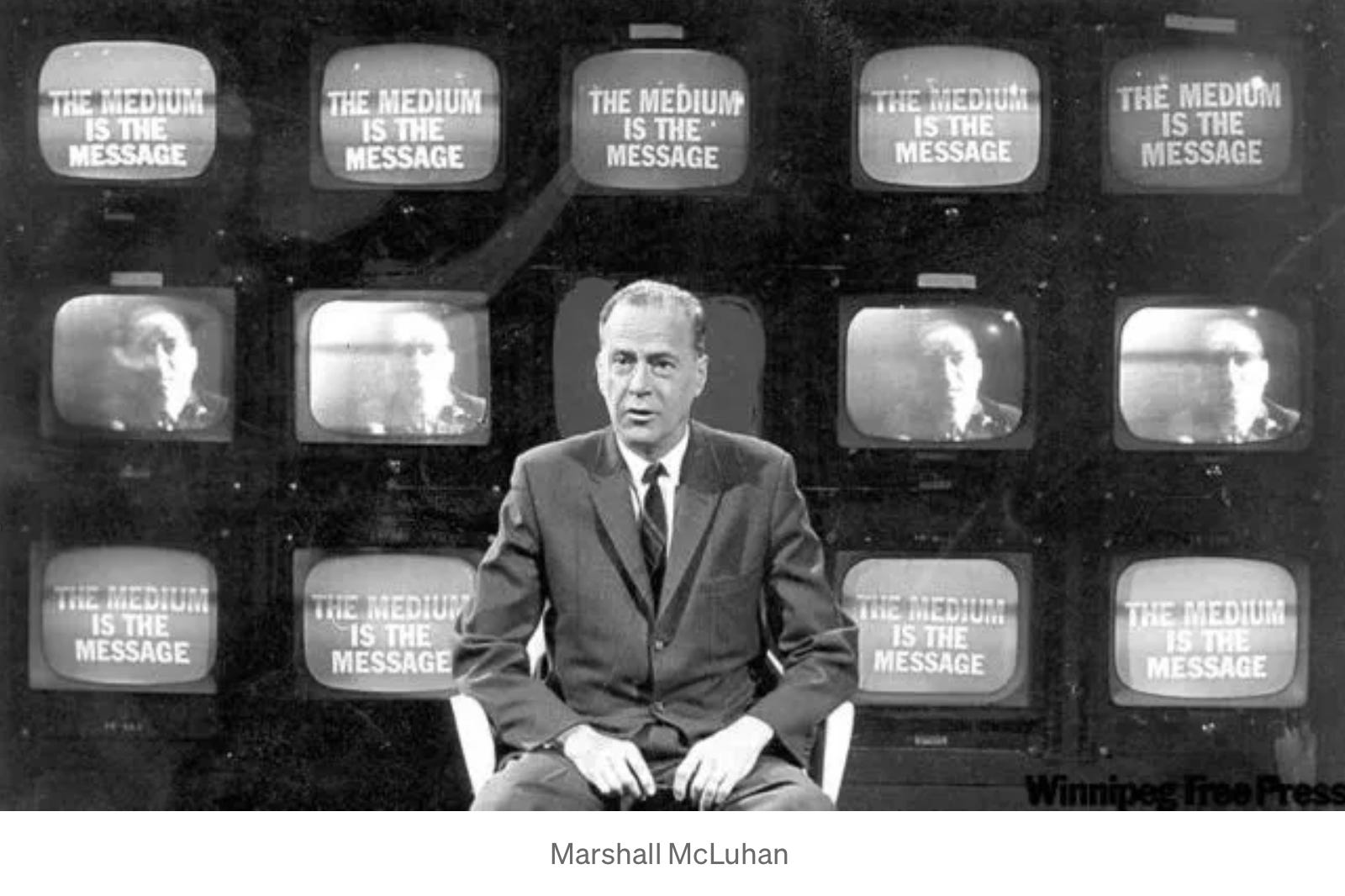
Are we now witnessing the cosmic religion of the future?
What we see now in this present moment, in my humble opinion, is indeed the immediate future of our endeavor.
More of the same is most likely—that is, without a sea-change in leadership and followership, plus genuine organizational reform. That’s my conclusion after more than a month of dialogue with many of you, plus some searching prayer as well.
Many good things are indeed brewing these days, but the momentum remains modest. The reception of the FER by what I believe to be the most approachable niches—adventurous youth, progressive clergy, and open-minded scholars—will remain limited.
In this connection, one loyal friend and subscriber, Richard Rosen, wrote a full-fledged essay in response to this inquiry, posted just below this missive. Richard says that he is happy, or at least accepting, of the U-movement’s present. He states that “critical mass has been achieved.” Please scroll down and have a close look at it. He takes me to task on many points, including the idea that a highly targeted outreach campaign to certain niche influencers (listed just above) is now needed.
A proposal for unifying and harmonizing the Urantia movement
You’ll recall that I started this inquiry with a slide show on movement history that was followed by a well-attended zoom discussion, entitled “Future of the Urantia Movement.” This content, too, is worth a review since we got a rich variety of perspectives.
And then after that I got a bit nasty—but in a nice way.
In my next post herein on Union of Souls, entitled “Salvington, we have a timing problem,” I speculated that in 75 years from now, only a tiny sliver of educated Christians will find Part IV recognizable and inspiring. More important, I went so far as to say that the ideal window for the dissemination was between 1990 and 2015—and that’s because Part IV is rhetorically aimed at the liberal wing of the Christian church, whose decline has since then has been precipitous. This means that the year 3,000 simply can’t work as an ultimate objective, as has been suggested by some of our leaders.
I got in a bit of trouble for this opinion, but I consider it “good trouble” (if I may quote the civil rights leader John Lewis).
You’ll recall that I concluded my last missive by saying, for consolation: “Hold steady, I will cover a more hopeful perspective in my next post!” And so here it is, an optimistic suggestion for U-movement organizational reform called, “Build the Unity Team.”
The idea here is that the present moment doesn’t feel quite right to some of us, largely because of the schismatic division of the movement that first began in 1989, and which had roots much earlier. (See the aforementioned slide show.) And I’ve done some homework on this proposition, since I gave a well-received talk on that very subject in 2024 at the American Academy of Religion meeting in San Diego.
Anyway, here goes—and the last section is forthcoming. After perusing this, please page down to the essay by Richard Rosen for a counterpoint.
Build the Unity Team
A proposal for unifying and harmonizing the Urantia movement (April 23)
Preamble:
We live in a divided world where many destructive wars are being fought. In the face of this great crisis of conflict, we stand as representatives for a great revelation, one that literally advocates world unity; we are also advocates for the updated teachings of Christ Michael, his gospel of love, healing, and reconciliation. If we are to be a credible witness to our troubled world, decency and commonsense require that we ourselves “be that which we want to see in the world.” And yet, our own movement is in conflict and gridlocked in a divided state; now is the time to present a united front to a world that needs healing, but this endeavor requires a unified Urantia movement. The first obvious step in this process of “cleaning up our own house” is to recognize the schism at the heart of our community. We will also need to acknowledge that previous efforts to build unity are not working. Sincere dialogues by leaders in the separated organizations have not yet born significant fruit over many years. So, here is another approach.
Proposal:
To get started, I suggest that a Unity Team be created that is devoted to building movement unity and harmony. This ambitious teamwork would proceed over months and years in several steps, but it would not consist of the same set of “leaders in the separated organizations” (as alluded to above). Instead, it would draw from those who have already served and are now independent of day-to-day pressures. Preferably, these “elders” would be past presidents of the currently separated organizations (of which there are three, or possibly four).
Provisions:
I am holding this part back right now, but there are ten of these. Contact me if you want to see the list, otherwise I will post it soon—after I refine it!
Next: An essay by Richard Rosen, April 2026
A case for the evolutional growth of the Fifth Epochal Revelation in contrast to the rapid promotion of the Urantia Book
Richard Rosen, April 2026
The spiritual idealism of Urantia Book devotees urges them on to share the revelation with as many as they can. And why not? Look what it has done for us, and love moves us to do good to others by sharing the Fifth Epochal Revelation. Furthermore, might not the world already immersed in an interregnum (between the fading stability of Christian tradition and not yet emerged individual God-knowingness) find its way out (and thus the urgency)?
Patience (tempered zeal) or a “massive branding campaign?”
There is an inherent cycle to growth that cannot be rushed without danger. Does the apparent value to the world of the Urantia Book justify the launching of a professional marketing campaign that extensively and rapidly makes known the name “Urantia” and particular content? Is such marketing wise? Might it incite fervid religionists to call out the workings of the Evil One? Might it bring about the unintended consequence of secularists and their media organs converging on a new cause célèbre?
In contrast, I contend that critical mass has been achieved, meaning:
· A sufficient number of people throughout the world recognize the revelation for what it is, and, as true evangelists, avidly share as occasion allows.
· Organizational infrastructure has been developed to support outreach.
· Of crucial importance is the advent of the internet over the last 30 years. For it has enabled an ever-increasing number of students of the Revelation to disseminate it by this means. It has provided a readily accessible means for those who hunger for truth to find it in numbers much greater than was possible when only the printed book was available.
What about comparison with the apostles and early church that rapidly spread the gospel, following Jesus’ injunction, “Go into all the world proclaiming this gospel to all nations, to every man, woman, and child” (165:6.3)? The early church, although well-meaning, focused on making as many people believers in Jesus in the shortest time possible. Their zeal propelled them. They did this by theological compromise and focusing on the divine Jesus, leading with the “miracle” of his resurrection from the dead. This invites the question: is the widespread and rapid promulgation of the early church that ended in the gospel of Jesus being cocooned in the Christian church a model to be emulated and admired?
Is it good that the Urantia Book become more widely known? Yes. Nevertheless, any good thing taken to an extreme becomes bad. And that is what a “massive branding campaign” heralds to me. The early church went about their promulgation wrongly (despite widespread and rapid acceptance). In my opinion, likewise would be the launch of an aggressive marketing campaign.
Is there a window of time we must act upon?
Here’s what is said in The Publication Mandate:[i]
The Book belongs to the era immediately to follow the conclusion of the present ideological struggle. That will be the day when men will be willing to seek truth and righteousness. When the chaos of the present confusion has passed, it will be more readily possible to formulate the cosmos of a new and improved era of human relationships. And it is for this better order of affairs on earth that the book has been made ready. But the publication of the book has not been postponed to that (possibly) somewhat remote date.
I disagree with the interpretation that the ideological struggle refers to the end of the Cold War around 1990 when a 25 year window opened for the widespread recognition of the Urantia Book. Here is my reasoning:
· It speaks above to an “era,” not a minuscule period of time.
· Do these recent years demonstrate “the day when men will be willing to seek truth and righteousness?”
· Has “the chaos of the present confusion…passed?”
· Does the recent 25 year window for dissemination correspond to “that (possibly) somewhat remote date” referenced above?
Evolution takes time, and the revelators timed the advent of the Revelation knowing it will take a long time for “the day when men will be willing to seek truth and righteousness.”
History of promotion efforts
There have been previous efforts to get the Urantia Book more widely known. These are three:
1940s— Harold Sherman knew how to market. He rebelled against Doctor Sadler’s leadership, in part, because he would not employ marketing techniques to rapidly spread the knowledge of the Urantia Book.
1950s—The book was sent to all members of Congress without a response.
1980s—Meredith Sprunger did a personal campaign to fellow ministers. This had some success. “Starting in 1983, we sent letters along with a pamphlet and an offer of a loan book to all of the United Church of Christ ministers in the United States and the United Methodist ministers in the Northern Indiana Conference. From the 8,000 personal letters sent, there were 330 ministers who asked for loan books. This 4% request for loan books was greater than the 1% which we hypothesized would ask for books. Around 25% of those who examined the book have purchased their own personal copy.”[ii]
Avoiding an interregnum
Does the distress and potential disaster the world is experiencing mean that now is the time for the revelation to be mightily promoted to people of influence who might make a difference? The calamity of the fall of Roman civilization was not sufficient for the true teachings of Jesus to emerge from the cocoon of the Catholic Church. What makes it different now?
There are those who believe that the widespread recognition of the Urantia Book may prevent catastrophe and diffuse an interregnum. This is predicated on the recognition that change to civilization and society’s institutions can come about only by a sufficient number of individuals centering their inner lives around God. Realistically, how many desire to be God-knowing in this material comfort age dominated by the profit motive and infused with materialism, humanism, and secularism? How many individuals are there in positions of influence who hunger for truth and thirst for righteousness? And how many have even the capacity to receive the Fifth Epochal Revelation? Similarly, how many were prepared to receive the gospel of the Fourth Epochal Revelation and share their inner lives with God? Not many as evidenced by the gospel about Jesus replacing the gospel of Jesus. Why would it be different for this epochal revelation?
Final thought: I shared the concept of an interregnum with a sincere Christian religionist. She said, “that may be just what’s needed to correct things.”
What is really needed?
Are we tasked by the revelators to make known the Urantia Book to as many as possible—at least thought leaders—in as short a time as possible? Or is it to reveal the truths of the Fifth Epochal Revelation as embodied in the lives of those who have taken it to heart? I like how Sheila Keene-Lund put it:
“Jesus did not center his mission on publicity, institutional reach, or cultural influence. He centered it on doing the will of God and growing in character….Such transformation will attract others, the movement will grow organically, and its influence will gradually be reflected in our homes, our communities, and eventually in our societies.”[iii]
The Urantia movement is the social structure in which individuals rise into the personal spiritual experience of a relationship with the Father that the world might see “Jesus living again on earth in the experience of all men” (195:10.1). The Urantia movement is a placeholder to keep vital the Fifth Epochal Revelation until “many forward-looking individuals are hungering for knowledge and thirsting for wisdom,” the fourth developmental epoch, the quest for knowledge and wisdom (50.5.7).
Meanwhile, to make the effort to birth the baby before its time is dangerous. So what to do? Just live, don’t try so hard to spread the revelation. Trust the Supreme to take care of that in his time, when the world sees “Jesus living again on earth in the experience of all men”. Or to paraphrase 181:2.20, when a critical mass of individuals are able to say, “He who has seen me has seen Jesus.”
[i] https://urantia-association.org/publication-mandate
[ii] https://archive.urantiabook.org/archive/mjs_archive/mjs_clergy_evaluate_II.htm
[iii] https://urantiabook.org/learn-with-others/news-and-discussion
I am not convinced that the so called publication mandate is inspired, but I do agree with Richard that slow and steady wins the race. We are not yet ready to deal with the revelation going viral. We need a lot more people stable in the true philosophy of the UB before we could handle a large influx without having it dominated by a single group or fragmenting into multiple fractions. We need some spiritually unify first. I like your idea of a unity team.
I have been reading the Urantia Book since 1978. I've been worried (even more so in the last 20 years) that an epochal revelation in book form is no good in a generation that doesn't read. I like the fact that more long form videos have been produced as this is more appropriate for this generation.